

Pow Wow Manawan
By Susan Dubé
This weekend, I attended my very first Pow Wow. Yes, my very first one—even though these celebrations have been open to everyone since the 1960s. Let’s just say I’m arriving a little late… only a few decades behind!
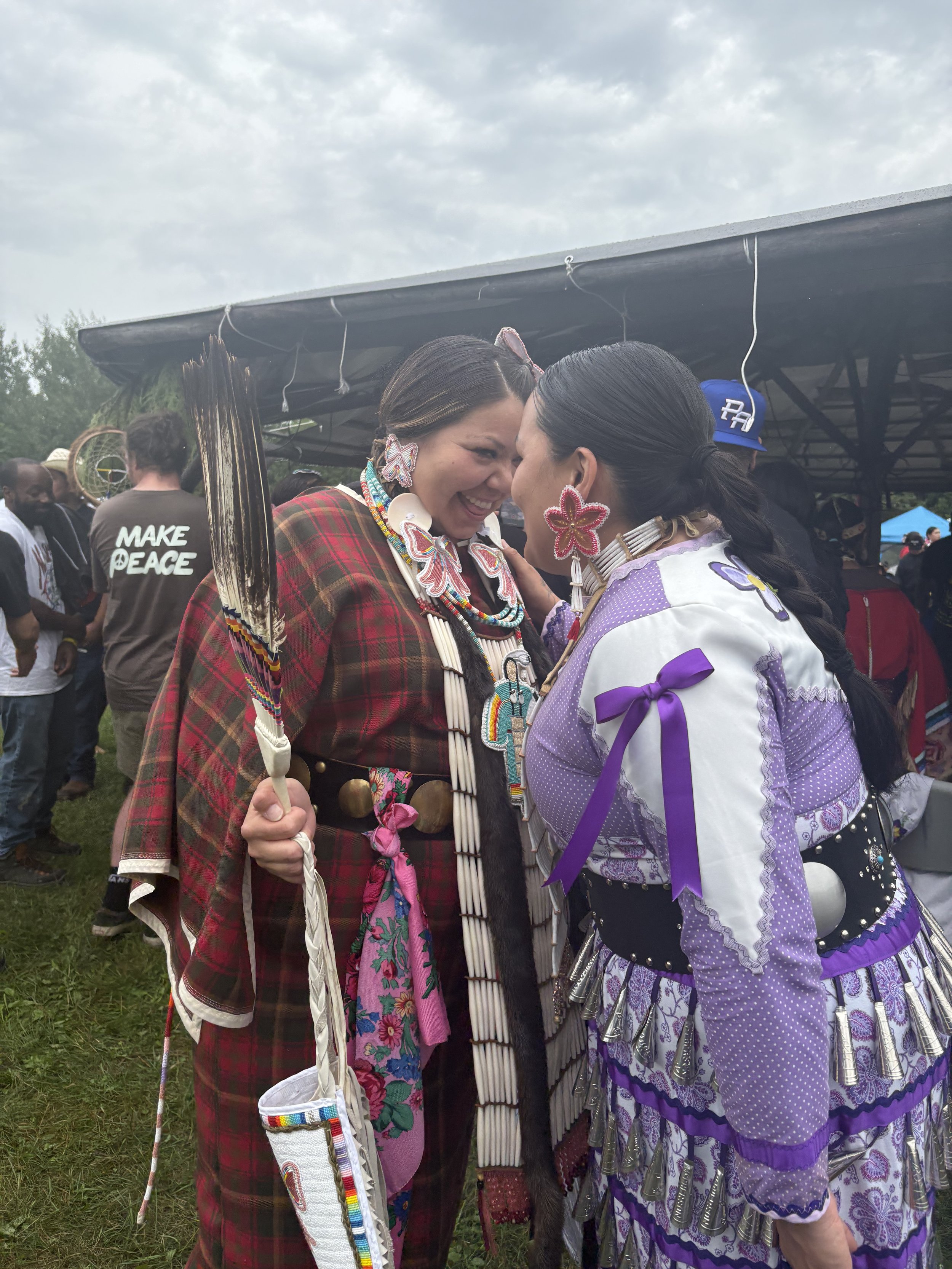
From the official opening, with the deep sound of the drums, the singing, and the sight of magnificent clothing decorated with beads, feathers, and vibrant colours, I was deeply moved. There was something powerful, alive, and profoundly rooted in what I was witnessing.
First Nations people celebrate their ancestors, life, memory, and the passing down of traditions through songs and dance. The Grand Entry, a sacred tradition, particularly moved me. Everyone stands with the same kind of respect we show when our national anthem is played in Canada.
Afterwards, we were invited to visit the booths, meet families, and discover the meaning and symbolism behind different objects, gestures, and traditions.
What touched me most was their generosity. We were not simply spectators; we were invited to participate, to dance, and to celebrate with them. What a beautiful display of openness and hospitality!
I would have loved to learn even more, especially when I saw women carrying such precious knowledge about healing. But perhaps it wasn’t exactly the right moment to pull out my notebook and ask for a crash course on Quebec’s medicinal plants!
The most ironic part of the experience is that I went there with the organization Mon Afrique à Lanaudière. Sometimes, it takes encountering another culture to help us discover and appreciate the cultures that are right beside us.
We Quebecers sometimes forget to connect with other cultures, to allow ourselves to be surprised, and to open our ears and our hearts. Recognizing this is already a step toward greater openness to other nations.
And as for me, I continue to dream of a more inclusive world—a world where we all dance together a little more often!
Pow Wow Manawan par Susan Dubé
En fin de semaine, j’ai assisté à mon tout premier Pow Wow. Oui, oui, mon premier… même si ces célébrations sont ouvertes à tous depuis les années 1960. Disons que j’arrive avec un léger retard à peine quelques décennies! Dès l’ouverture officielle, au son profond des tambours, des chants et devant les vêtements éclatants sertis de perles, de plumes et de couleurs vibrantes, j’ai été touchée. Il y avait là quelque chose de grand, de vivant, de profondément enraciné. Les Premières Nations y célèbrent leurs ancêtres, la vie, la mémoire et la transmission, au rythme des chants et de la danse. La Grande Entrée, cette tradition sacrée, m’a particulièrement émue : tout le monde se lève, avec le même respect que pour notre hymne national au Canada. Ensuite, nous étions invités à visiter les kiosques, à rencontrer les familles et à découvrir la symbolique derrière les objets, les gestes et les traditions. Ce qui m’a le plus marquée, c’est cette générosité : nous n’étions pas seulement spectateurs, nous étions invités à participer, à danser, à célébrer avec eux. Quelle belle ouverture de leur part! J’aurais aimé en apprendre encore davantage, surtout en voyant ces femmes porteuses d’un savoir de guérison si précieux. Mais bon, ce n’était probablement pas le bon moment pour sortir mon cahier de notes et demander un cours accéléré sur les plantes médicinales du Québec! Le plus ironique dans cette histoire, c’est que j’y suis allée avec l’association Mon Afrique à Lanaudière. Comme quoi, il faut parfois passer par une autre culture pour mieux aller à la rencontre de celles qui sont tout près de nous. Nous, les Québécois, oublions parfois de nous mêler aux autres cultures, de nous laisser surprendre, de tendre l’oreille et le cœur. Le reconnaître, c’est déjà faire un pas vers une plus grande ouverture aux autres nations. Et moi, je continue de rêver d’un monde plus inclusif…un monde où l’on danse un peu plus ensemble !
Manawan Pow Wow: An African's Reflection on a Living Heritage
By Kwesi Wurapa
Many people call me Kwesi simply because I was born on a Sunday, according to the Akan naming tradition of Ghana. But for us, a name is more than the day of one's birth. It carries expectations, character, identity, and a connection to our ancestors. Long before I learned about personality theories in school, I had already grown up with the understanding that our elders believed a person's day of birth revealed something about their temperament. Family upbringing and life's experiences may shape us, but they do not erase the original imprint.
With that understanding, I arrived in Manawan eager to discover whether there were similarities between the ancient traditions of Canada's First Nations and those of Africa.
The journey itself prepared my mind for the experience. We travelled far beyond the busy towns until the paved roads gave way to rougher paths. Soon, every mobile phone in our vehicle lost its signal. I must admit, I was completely surprised that such a place still existed in Canada.
Ironically, I found it refreshing.
For a few hours, we were disconnected from the constant noise of modern life. There were no notifications, no endless scrolling, and no pressure to keep up with the clock. It reminded me of many rural communities in Africa, where nature still dictates the rhythm of life and people are free to simply be. In that moment, I felt strangely at home.
As we arrived, the rain welcomed us. The organizers announced that the program might have to be cancelled because of the weather. We all laughed nervously. Yet, within about ten minutes, the skies cleared as though nature itself had changed its mind, and the celebration began.
What unfolded before us was not merely entertainment. It was the preservation of a civilization.
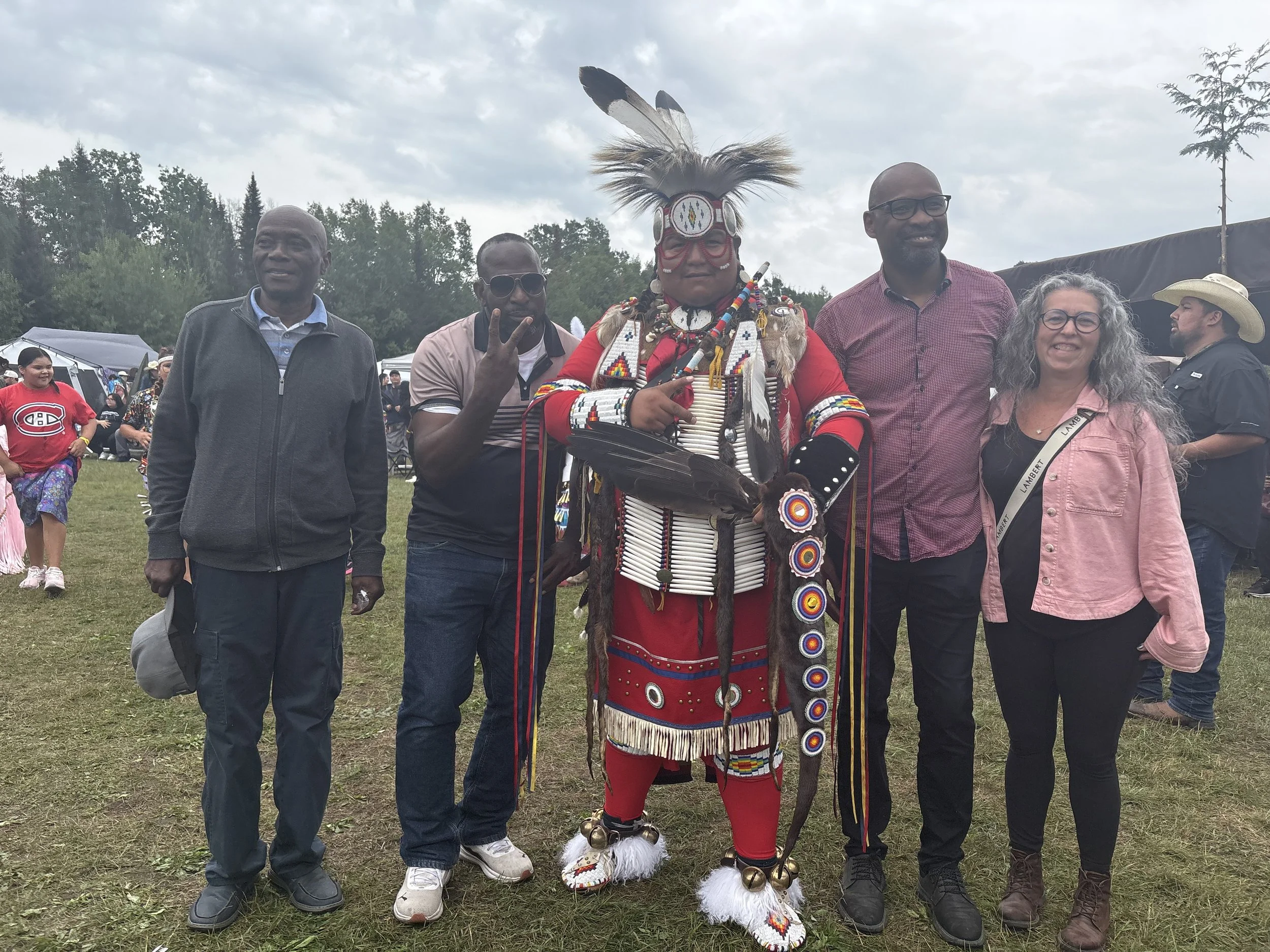
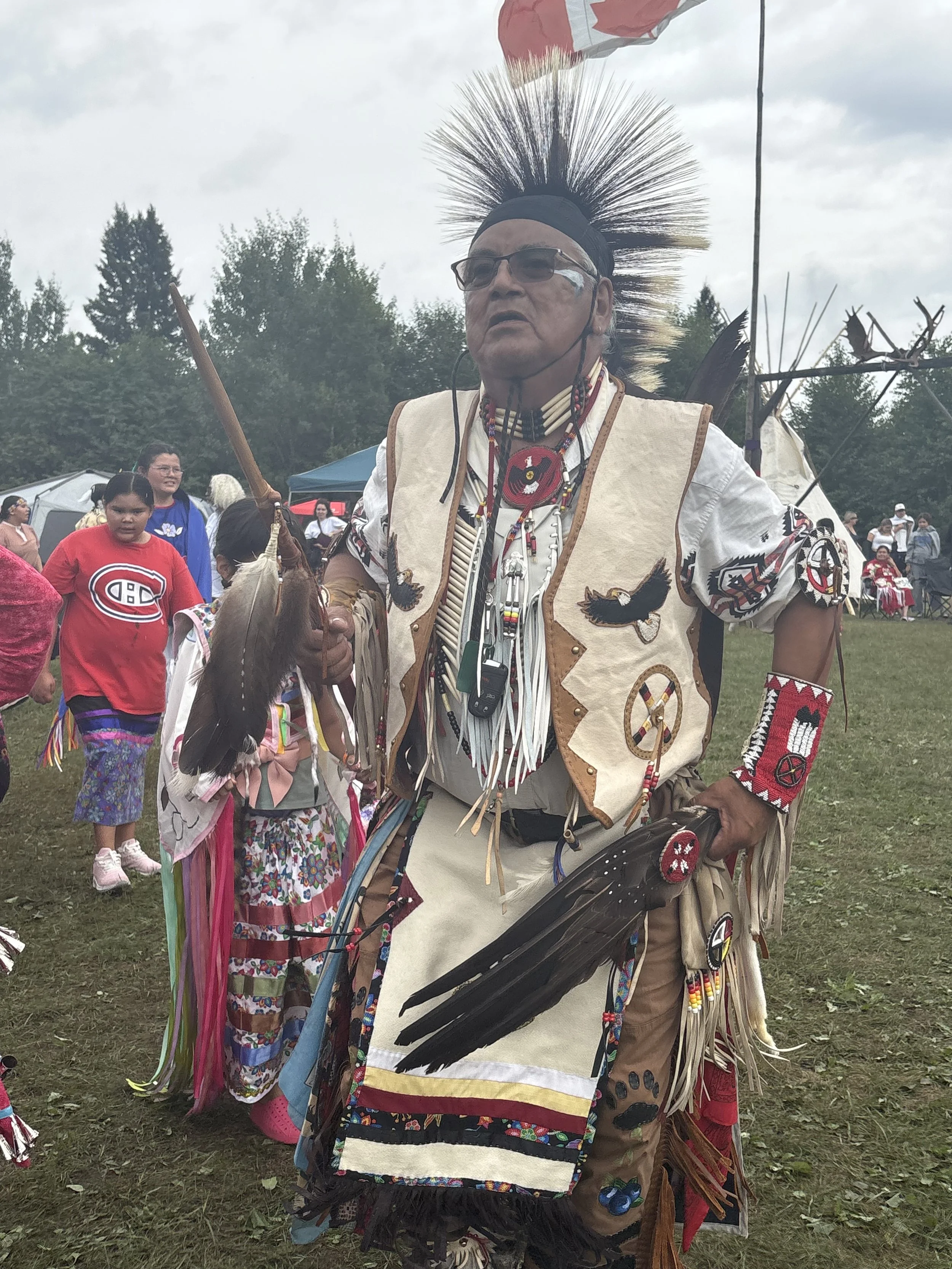
For well over a century, generations have gathered to ensure that their history is never forgotten. Children proudly walked beside their parents and grandparents, learning through participation rather than textbooks. I watched mothers and fathers carefully helping their children put on beautifully crafted regalia decorated with beads, feathers, animal skins, and vibrant colours. It was more than dressing for an event—it was clothing the next generation in identity.
Every dance, every drumbeat, every song, and every ceremonial movement carried a lesson. Respect. Love. Unity. Peace. Community. These were not simply words spoken from a stage; they were values woven into every part of the celebration.
As an African, I could not help but notice familiar symbols.
Many of the garments and ceremonial items were fashioned from animal skins, feathers, claws, scales, and horns. That was not foreign to me. Across many African cultures, such symbols have long represented courage, leadership, wisdom, protection, and humanity's relationship with the natural world.
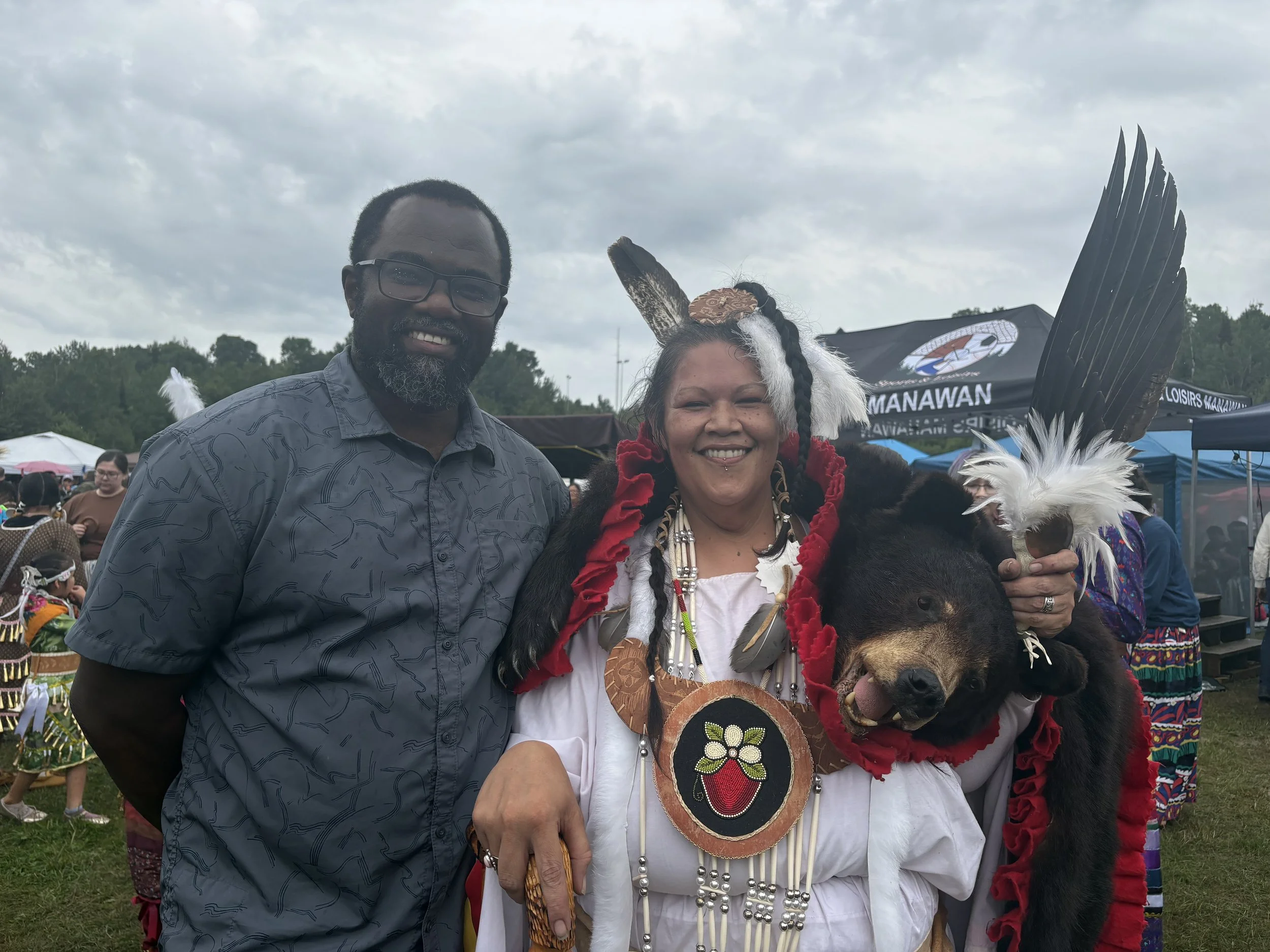
Whether it was the image of a bear, a bull, a snake, or another powerful creature, I saw reminders of humanity's enduring struggle to survive and flourish. These animals once represented real challenges faced by our ancestors. Today, they have become symbols of memory, identity, and resilience.
I was equally fascinated by the honour given to traditional knowledge keepers, many of whom were women. Their presence reminded me of the respected herbalists, healers, and family doctors found throughout many African societies. Long before modern hospitals, communities depended upon their wisdom to heal the body, guide the spirit, and preserve generations of knowledge. Watching the ceremonies, I was reminded that women have always been pillars of civilization, even if history has not always given them the recognition they deserve.
The exhibition tents displayed countless handcrafted items made from materials provided by nature. Every piece reflected patience, creativity, and a profound respect for the environment. Nothing appeared wasteful. Everything had meaning.
As the day drew to a close, the rain returned.
Some smiled and suggested that perhaps the ancestors had heard the prayers of the people of Manawan.
Whether one believes that or not is a matter of personal faith.
What cannot be denied is that the spirit of the celebration touched everyone present.
I left Manawan with something greater than photographs. I left with a renewed appreciation that, although oceans separate our peoples, Indigenous cultures and African cultures share remarkable similarities. Both understand that identity is preserved through storytelling. Both honour their ancestors. Both teach their children through participation rather than instruction alone. Both recognize that humanity flourishes when it lives in harmony with nature, family, and community.
As a Ghanaian visiting the homeland of Canada's First Nations, I did not simply witness another culture.
In many ways, I recognized echoes of my own.
And perhaps that is one of the greatest lessons of all: when we take the time to understand another people's story, we often discover reflections of ourselves.

When Taste Redefines Culture: Discovering Adom’s Delight in Montreal
Some cultural lessons are not learned through books or speeches. They are transmitted differently — through aromas, textures, and the age-old act of sharing a meal.
That is precisely what my partner and I experienced during our recent visit to Adom’s Delight, a restaurant located inside the Marché Africain on Jean-Talon West in Montreal. It was my first visit — and also my first time eating with my hands. A small detail, perhaps, but one that fundamentally changes the relationship between diner and dish. Here, food is not simply consumed; it is experienced.
The space is modest and intimate. Yet it carries something far more meaningful than visual appeal: a deep respect for culture. The chef — warm, attentive, and generous — welcomed us not as passing customers, but as guests. She took the time to ensure we were comfortable, satisfied, and generously served. Portions are abundant, flavours are bold and layered, and the atmosphere is defined by genuine hospitality.
The woman who runs the restaurant is Ghanaian, and her heritage is expressed without artifice. Too often, dishes are loosely associated with geography without fully understanding the people behind them. Truly tasting a cuisine, however, has a way of correcting assumptions. What once seemed familiar becomes revelatory; what felt distant becomes personal. Here, flavour tells a story with more honesty than labels ever could.
Adom’s Delight does not seek to impress through décor or spectacle. Its strength lies elsewhere — in authenticity. It asks only one thing of its visitors: openness. Be bold enough to enter. Be curious enough to taste.
For The Maple Chronicles, the conclusion is clear: Adom’s Delight may not be eye-catching at first glance, but it offers an experience that is sincere, grounded, and deeply human. And more often than not, it is places like these that leave the most lasting impressions.
Interior Design
✳︎
✳︎
Grillades Yelkabe restaurant Africain, rue St-Jean Ville de Québec
Grillades Yelkabe restaurant Africain, rue St-Jean Ville de Québec
Grillades Yelkabe restaurant Africain Ville de Québec
Grillades Yelkabe restaurant Africain Ville de Québec
✳︎
Remodels
✳︎
Commercial Design
Commercial Design
Interior Design ✳︎ ✳︎ Grillades Yelkabe restaurant Africain, rue St-Jean Ville de Québec Grillades Yelkabe restaurant Africain, rue St-Jean Ville de Québec Grillades Yelkabe restaurant Africain Ville de Québec Grillades Yelkabe restaurant Africain Ville de Québec ✳︎ Remodels ✳︎ Commercial Design Commercial Design
Popular

2025
New York
The Atlast Project →
“Communication was top-notch and the final outcome was even better than we imagined. A great experience all around.”
Former CustomerGet In Touch
If you're interested in working with us, complete the form with a few details about your project. We'll review your message and get back to you within 48 hours.