
By Kwesi Wurapa
Many people call me Kwesi simply because I was born on a Sunday, according to the Akan naming tradition of Ghana. But for us, a name is more than the day of one's birth. It carries expectations, character, identity, and a connection to our ancestors. Long before I learned about personality theories in school, I had already grown up with the understanding that our elders believed a person's day of birth revealed something about their temperament. Family upbringing and life's experiences may shape us, but they do not erase the original imprint.
With that understanding, I arrived in Manawan eager to discover whether there were similarities between the ancient traditions of Canada's First Nations and those of Africa.
The journey itself prepared my mind for the experience. We travelled far beyond the busy towns until the paved roads gave way to rougher paths. Soon, every mobile phone in our vehicle lost its signal. I must admit, I was completely surprised that such a place still existed in Canada.
Ironically, I found it refreshing.
For a few hours, we were disconnected from the constant noise of modern life. There were no notifications, no endless scrolling, and no pressure to keep up with the clock. It reminded me of many rural communities in Africa, where nature still dictates the rhythm of life and people are free to simply be. In that moment, I felt strangely at home.
As we arrived, the rain welcomed us. The organizers announced that the program might have to be cancelled because of the weather. We all laughed nervously. Yet, within about ten minutes, the skies cleared as though nature itself had changed its mind, and the celebration began.
What unfolded before us was not merely entertainment. It was the preservation of a civilization.
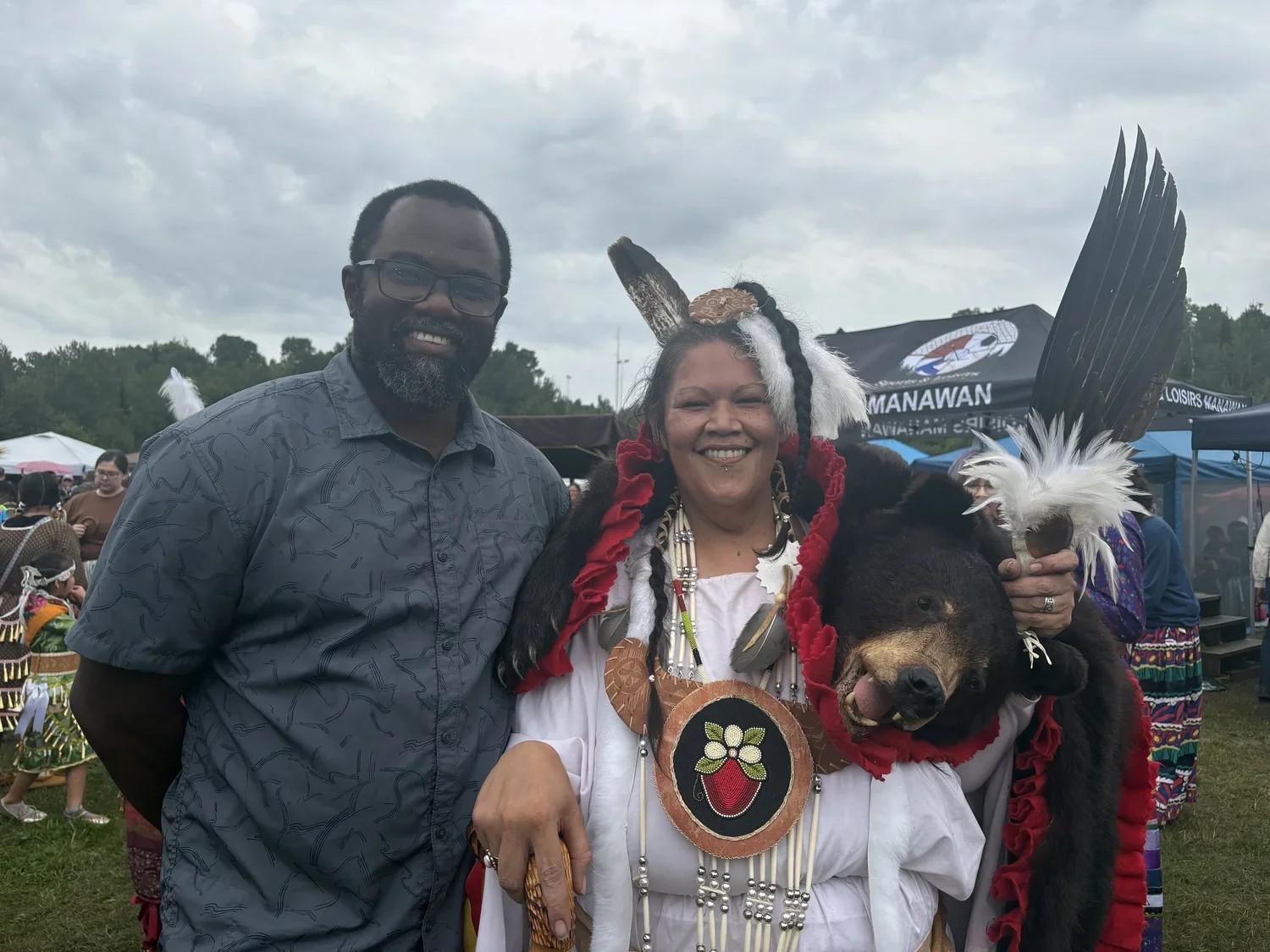
For well over a century, generations have gathered to ensure that their history is never forgotten. Children proudly walked beside their parents and grandparents, learning through participation rather than textbooks. I watched mothers and fathers carefully helping their children put on beautifully crafted regalia decorated with beads, feathers, animal skins, and vibrant colours. It was more than dressing for an event—it was clothing the next generation in identity. Every dance, every drumbeat, every song, and every ceremonial movement carried a lesson. Respect. Love. Unity. Peace. Community. These were not simply words spoken from a stage; they were values woven into every part of the celebration.
As an African, I could not help but notice familiar symbols. Many of the garments and ceremonial items were fashioned from animal skins, feathers, claws, scales, and horns. That was not foreign to me. Across many African cultures, such symbols have long represented courage, leadership, wisdom, protection, and humanity's relationship with the natural world.
Whether it was the image of a bear, a bull, a snake, or another powerful creature, I saw reminders of humanity's enduring struggle to survive and flourish. These animals once represented real challenges faced by our ancestors. Today, they have become symbols of memory, identity, and resilience.
I was equally fascinated by the honour given to traditional knowledge keepers, many of whom were women. Their presence reminded me of the respected herbalists, healers, and family doctors found throughout many African societies. Long before modern hospitals, communities depended upon their wisdom to heal the body, guide the spirit, and preserve generations of knowledge. Watching the ceremonies, I was reminded that women have always been pillars of civilization, even if history has not always given them the recognition they deserve.
The exhibition tents displayed countless handcrafted items made from materials provided by nature. Every piece reflected patience, creativity, and a profound respect for the environment. Nothing appeared wasteful. Everything had meaning.
As the day drew to a close, the rain returned. Some smiled and suggested that perhaps the ancestors had heard the prayers of the people of Manawan. Whether one believes that or not is a matter of personal faith.
What cannot be denied is that the spirit of the celebration touched everyone present.
I left Manawan with something greater than photographs. I left with a renewed appreciation that, although oceans separate our peoples, Indigenous cultures and African cultures share remarkable similarities. Both understand that identity is preserved through storytelling. Both honour their ancestors. Both teach their children through participation rather than instruction alone. Both recognize that humanity flourishes when it lives in harmony with nature, family, and community.
As a Ghanaian visiting the homeland of Canada's First Nations, I did not simply witness another culture.
In many ways, I recognized echoes of my own.
And perhaps that is one of the greatest lessons of all: when we take the time to understand another people's story, we often discover reflections of ourselves.
